 sales CRMHospices · palliative care · care units
The call often comes in the evening, after a talk with a doctor.
- Calls and inquiries go straight to a record
- Intake: mobility, swallowing, who decides
- Missed calls listed separately
A family’s inquiry becomes a record with an owner, beds are visible on one board, care is logged from the nurse’s phone. Diagnoses and relatives’ details are stored encrypted.
Why 95sales
Compare with:CliniccardsMedeskBitrix24amoCRMHubSpotPipedriveNetHuntFinmapExcelall comparisons →
What a palliative team needs
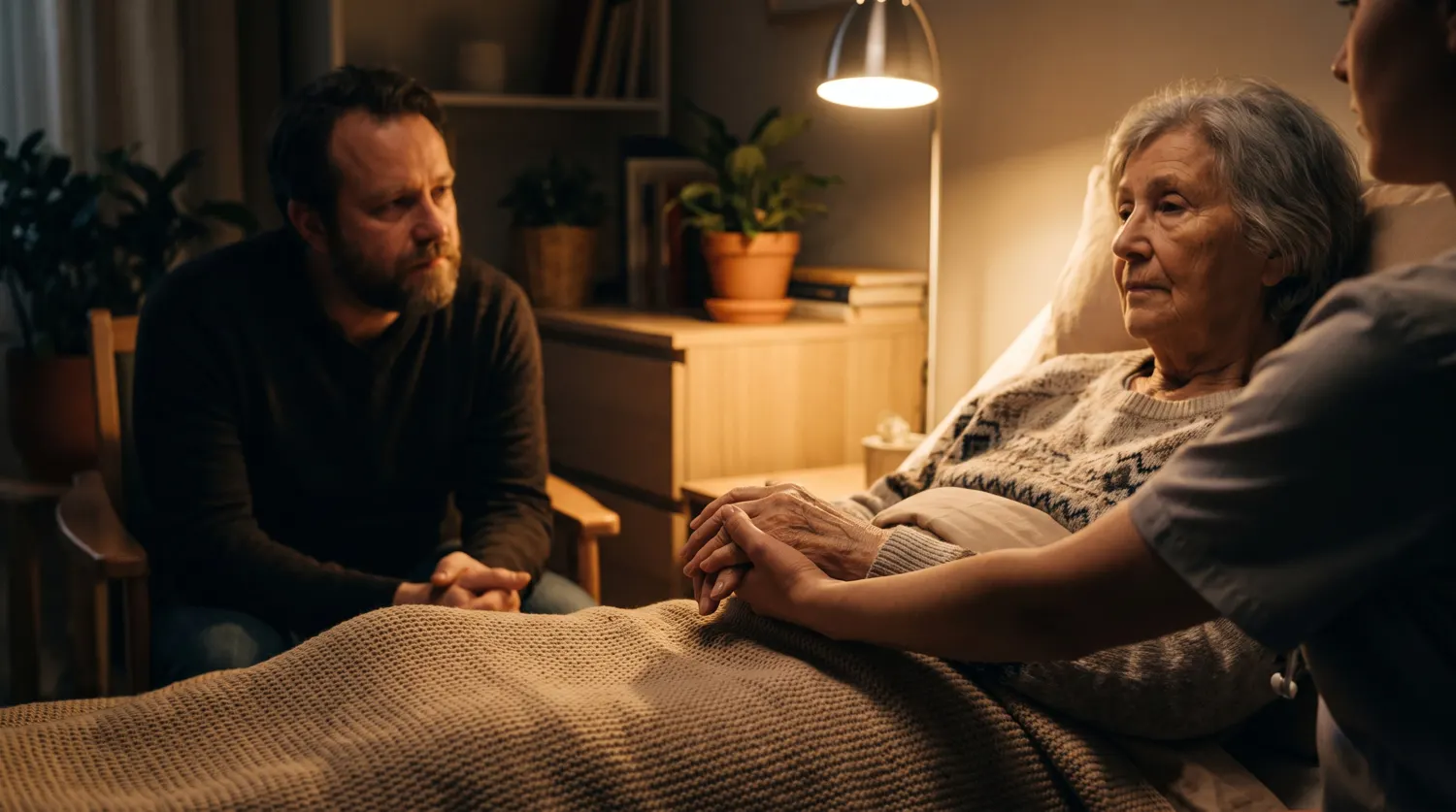
The family needs fast, clear answers, the patient needs regular care, and the team needs order without extra work.
The call often comes in the evening, after a talk with a doctor.
Hospitals and doctors refer patients.
Who’s arriving today and where a bed will free up.
Regular care is about a person’s dignity.
Staff know the exact amount before talking to the family.
Diagnoses and relatives’ contacts under lock.
We’ll show the patient journey on a demo — from a family’s call to the care plan.
Show me →What the CRM does
Pick what takes up most of your team’s time — and see how it works.
Charges, family payments, cash desks and the center’s profit add up by themselves. Occupancy and the month forecast are visible before the month closes.
Screens are from the real CRM; people and amounts are fictional.
Where time slips away
Families decide on hospice care quickly, at a hard moment. If the inquiry is jotted on a scrap of paper and never handed over, they call the next place — and your center couldn’t help someone it could have.
How it works
Five steps where every detail matters — and how the CRM helps your team miss nothing.
The team on their phones
Nurses, front desk and the manager work from their phones: the CRM installs on the home screen like an app. Everyone sees only what their job needs.
For the manager
Occupancy, referrers, money and the center’s profit — no spreadsheets to reconcile. The planner gathers family call-backs, admissions, documents and payments for the week, and the team confirms urgent alerts as read.
See it on a sample
Hundreds of transactions sort themselves into categories: income, expenses, profit and margin by month — no Excel, no accountant.
Monthly P&L: expense groups expand into categories, projects, margin
Plan vs actual: a monthly budget by category, overspending visible mid-month
CRM + Finmap or one system
A payment lands in the CRM, then someone copies it into finance and reconciles. See what two services plus double entry really cost — in money and in staff hours.
95sales client reviews
The same 95sales team has run ads, analytics and sales for clinics, SaaS and e-commerce for years. The CRM grew out of that work — here’s what clients say about us.
Verified 95sales contracts on Upwork
See the CRM in action.30 minutes, on your center’s example.
Book a demo → team
Who builds and rolls out the CRM
The CRM is set up and supported by the people who build it — no call center, no handing you to a junior after you sign.
What’s included
Usually it’s a spreadsheet, a messenger, an accountant and a notebook at the nurse station. Here it’s one CRM where everyone has a role.
Not sure it fits you?Describe your center — we’ll reply in one message how the CRM fits your process.
Describe my center →It all starts with a demo.30 minutes — and you’ll see the CRM on your own center’s example.
Book a demo →
Free, before any contract
Medical data
We built the CRM so it’s hard to leak even from the inside.
Security2FA by role, screen lock, watermark, support access only with your permission.
Activity logWho did what and when — visible to the owner.
Questions about data protection?
Ask on a demo →Objections
“Hospice care isn’t about sales”
True. Here the CRM makes sure no family inquiry gets lost, and that care and paperwork don’t eat into staff time.
“Nurses have no time for software”
Her phone shows only her patients and a “Done” button. It’s faster than a paper sheet.
“The data is too sensitive”
Diagnoses, relatives’ details and the care log are encrypted; access is strictly role-based and every action is logged.
“We already have a medical system”
The CRM doesn’t replace it: your EHR keeps the medical record, the CRM handles inquiries, beds, scheduled care and payments. They run side by side.
What it costs
Start
$99 per month
One clinic or center: the whole CRM, no limits
over 300 calls — $0.08 per call
Pick on the demo →Business
$199 per month
A clinic with a sales team and ads
Everything in Start, plus:
over the limit — $0.06 per call, $0.12 per question
Pick on the demo →Network
$499 per month
A network of centers: network finance and large AI limits
Everything in Business, plus:
over the limit — $0.05 per call, $0.10 per question
Pick on the demo →No annual contracts. Switch plans yourself, from the 1st. AI limit reached — pay per use at the plan rate or pause: your call, with an optional cap. Call limits assume the economy scoring model; the maximum model uses 5 reviews per call.
In every plan
The whole CRM on every plan — no limits on users, patients or transactions; plans differ only in AI limits
Included
One-off, priced upfront
Add-ons
The whole CRM is already in your plan. Add-ons bring extra channels and services on top and work with any plan.
Social inbox
+$39 per month
Instagram Direct, Messenger and comments in one window with your leads.
We connect your Meta accounts during setup.
Fiscal receipts (Ukraine)
+$19 per month
Ukrainian fiscal receipts (PRRO) straight from the CRM cash desk.
Runs on Checkbox; you pay its plan directly.
Reviews
+$29 per month
More ratings on Maps, and you hear about complaints first.
Messages go out via your Viber/SMS, like appointment reminders.
Turn an add-on on or off in CRM settings; it is billed from the 1st together with your plan. Not a fit within the 14-day trial: switch it off and pay nothing.
You pay nothing and owe nothing.
We discuss a subscription only if you want one after the demo. The price is known before you start.
In-depth guide
A hospice is different because the admission decision is almost always made by the family, not the patient — and made quickly, at a hard moment. The call often comes from the hospital after a talk with the doctor, in the evening or on a weekend. The family needs to know whether there's a bed, what care includes, which documents to bring and what it costs. If they don't get an answer within an hour, they call the next place.
After admission, what matters most is regular care: repositioning, hygiene, feeding and fluids, blood pressure and temperature checks. A mistake here costs not money but a person's dignity. That's why a palliative care center needs a system where care doesn't depend on one nurse's memory on one shift.
Common challenges palliative teams face:
Calls through Binotel or Ringostat (Ukrainian telephony providers; other systems connect through a generic webhook), website forms and ad leads go into the inquiry pipeline, and missed calls show up separately. The first-call intake form helps gather the essentials calmly: age, diagnosis, mobility, swallowing, speech, who makes the decision, who referred them, budget. The coordinator doesn't need to call the family back with follow-up questions.
The default stages are New → Qualification → Consultation → Waiting for a bed → Contract → Admitted → Lost, and you can rename them to match how your team talks. Reasons a family didn't come to you are kept in a list, which helps you see what the center is missing.
In palliative care, a large share of patients is referred by oncology departments, primary care doctors and hospitals. In the CRM, each referrer has its own record: how many patients they referred and how much revenue that brought the center. You can see which departments you have working relationships with and where nobody has heard of you.
The bed board shows every bed: occupied, waiting for a bed, ready to admit. On admission, the patient gets a site, a bed, a rate and a care level. On discharge, you record the date and reason — transferred to hospital, family's decision, goal achieved, or death. This data matters for honest center statistics and for follow-up with the family.
Each patient has their own care plan with individual intervals: repositioning, feeding, fluids, linen change, hygiene, blood pressure and temperature. The nurse sees on her phone what's due now and checks it off with one tap; if she didn't get to it in time, she can log it after the fact. Overdue tasks are highlighted, and vitals go straight into the record.
The care log captures observations, incidents and medications. At shift handover, the next nurse sees everything that happened — no verbal recap needed.
Hospital discharge summary, passport, power of attorney, contract, data processing consent — staff photograph the document with a phone, and the office reviews it and accepts it or asks for a fix. You can see whether a paper original exists and which documents are about to expire. The family doesn't have to bring the same thing twice.
Charges are built from the monthly rate, care level and extra services, payments are applied to the patient, and debts are shown by due date. Staff see the exact amount and payment history before talking to the family — no mistakes and no repeat requests. More in payments and debts.
Careful communication starts with the family not having to repeat their story to every new staff member. The patient record has a single activity timeline: calls, comments, documents, payments, changes in care. The coordinator, nurse and director all see the same thing, so the family gets consistent answers.
If a patient's condition changes, the head nurse sends an urgent alert to the team — with read receipts, so you can see who got it. Internal chats can be general, per site or direct: work discussions stay in the CRM, not in staff members' personal messengers. Tasks like "call the daughter after the doctor's consultation" go into the planner with a due date and don't get forgotten at shift change.
| Need | In 95sales CRM |
|---|---|
| Intake from calls, website and ads | Yes, with source and owner |
| First-call intake form (diagnosis, mobility, decision-maker) | Yes |
| Bed waitlist | Yes, "Waiting for a bed" stage |
| Referrer tracking (hospitals, doctors) | Yes |
| Care plan with phone check-off | Yes, PWA with push notifications |
| Care log, incidents, medications | Yes |
| Encryption of diagnosis and family data | Yes, AES-256 |
| Doctor notes with ICD-10 diagnosis | Yes, encrypted |
| Electronic medical record, eHealth, e-prescriptions | No — kept in your EHR |
| Charitable donation tracking | No dedicated module |
Say a palliative care center has 20 beds, and at 7 p.m. on Friday the son of a patient being discharged from an oncology ward calls.
In palliative care, data is especially sensitive: diagnosis, prognosis, family contacts. In 95sales CRM, the patient's diagnosis and relative, the care log and call transcripts are encrypted with AES-256 using a separate key for each customer. Each customer also has its own separate database.
Access is set by roles and permissions enforced on the server: the admissions coordinator sees inquiries, nursing staff see care, and finances are visible only to those who need them. There's 2FA, a session list, auto-lock after 60 minutes, watermarking, copy and print blocking, and every action is recorded in an audit log. More in data security and our guide to protecting medical data.
A hospice is like a care home in that both have beds, monthly billing and regular care, so the CRM's foundation is the same. The differences are a short and unpredictable length of stay, a bigger role for referrers, and higher demands for sensitivity and data protection. If your center combines both, everything runs in one system with separate sites. For care homes, see CRM for care homes.
FAQ

Yes: here a CRM makes sure no family inquiry gets lost, beds and care are visible to the whole team, and documents and payments don't eat up staff time.
The nurse sees the care plan on her phone, checks off tasks with one tap, and sees what's overdue. The care log passes between shifts without a verbal recap.
Diagnosis, family details and the care log are encrypted with AES-256, access is controlled by server-enforced roles, every action is logged, and 2FA is available.
Yes. Each referrer has a record showing how many patients they referred and how much revenue that brought the center.
No. Doctor notes with ICD-10 can be kept in the CRM, but eHealth, e-prescriptions and official medical forms stay in your EHR, while the CRM handles inquiries, beds, care, documents and payments. The two systems run side by side.
The CRM interface is available in English, Ukrainian and Russian; each user picks their own language in the profile. This site is available in the same three languages.
We store a traffic source marker in your browser so we can tell which ad or link brought an enquiry. Nothing is stored without your consent. Learn more